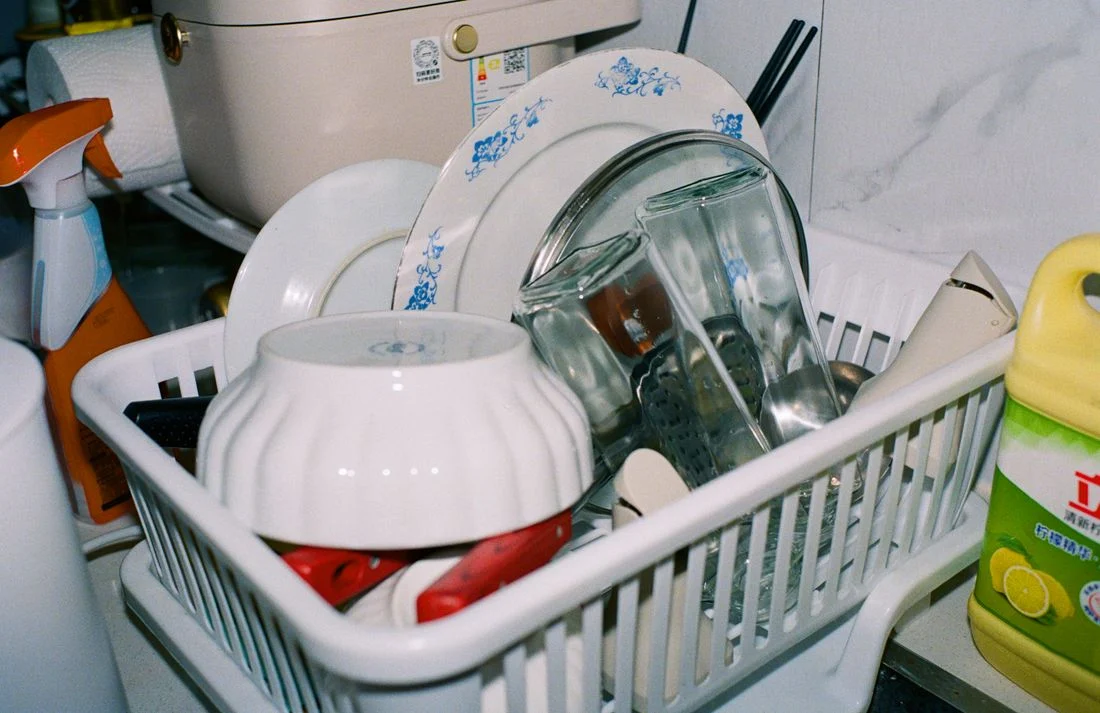
A dish rack can be too small for the dishes and too large for the counter at the same time. The solution begins with the way you wash. A household that uses a dishwasher and hand-washes only a few items needs a different arrangement from one that washes every pot, plate, and glass at the sink.
Measure the drying footprint
Include the rack, drainboard, utensil holder, and any projecting handles. If water is meant to drain into the sink, check that the spout reaches the basin and that the counter's shape allows the intended drainage. A rack that leaves water pooling around its feet creates another cleaning task.
Leave a usable work area for food preparation. Do not solve drying capacity by covering the only place where a cutting board can sit. In a compact kitchen, a rack that expands for a washing session or stores away afterward may be worth considering, provided setup is quick enough for ordinary use.
Test the difficult pieces
Compare the slots with your actual plates and the flat area with your usual saucepan. Tall glasses need stable support, and small utensils should not slip through the holder. Large knives and other sharp items require safe handling and placement rather than being dropped into an overcrowded cup.
An over-sink design can free counter space, but check basin size, faucet clearance, stability, and the manufacturer's load limits. It should not prevent normal use of the tap or block access to the sink. A roll-up mat is useful only for the items it can support securely.
Make cleanup part of the choice
Look for parts that can be removed and cleaned according to the maker's instructions. Narrow channels and fixed joints can be awkward to reach. The drainboard should also be easy to empty or rinse rather than permanently trapped beneath the rack.
Material appearance is secondary to how the product behaves around water in your kitchen. Read care instructions and avoid assuming every metal finish or wooden component tolerates the same conditions. Let the rack and dishes dry appropriately before storing a collapsible unit away.
For a week, notice whether the rack remains full because it is undersized or because dry dishes are never put away. Increasing capacity will not solve the second problem. A manageable rack, cleared regularly, often preserves more working counter than a large permanent drying station.