A dinnerware set can look complete on the shelf while leaving you short of the bowls you actually use. Perhaps the household eats soup and grain bowls most evenings, yet the set includes several small cups and saucers that rarely leave the cupboard. Start with a week's meals and the way you wash dishes, then decide what a useful collection contains.
Count place settings through a normal day
Think beyond the number of people at the table. If dishes are washed once each evening, breakfast bowls may still be waiting when lunch happens. If you wash after every meal, fewer pieces may be sufficient. Occasional guests add another requirement, but a twice-yearly gathering does not necessarily justify keeping a large formal set in the main kitchen.
Write down the pieces that get used repeatedly: dinner plates, smaller plates, cereal or soup bowls, and any particular shape your meals require. A broad shallow bowl can be versatile for some menus, while another household may prefer a deeper bowl and a conventional plate. Neither combination is universally better.
Check dimensions in three places
Measure the cupboard opening, the usable shelf depth, and the dishwasher rack if you use one. Large plates can collide with a cabinet door or interfere with the dishwasher's moving parts. Consult the dishwasher instructions and the dinnerware maker's care information rather than assuming that a standard-looking plate will fit.
At the table, compare the plate with the available place setting. A wide rim reduces the usable food area even when the overall diameter is large. On a small table, oversized plates can push glasses and cutlery toward the edge. Try a paper circle of the listed diameter if you are shopping online.
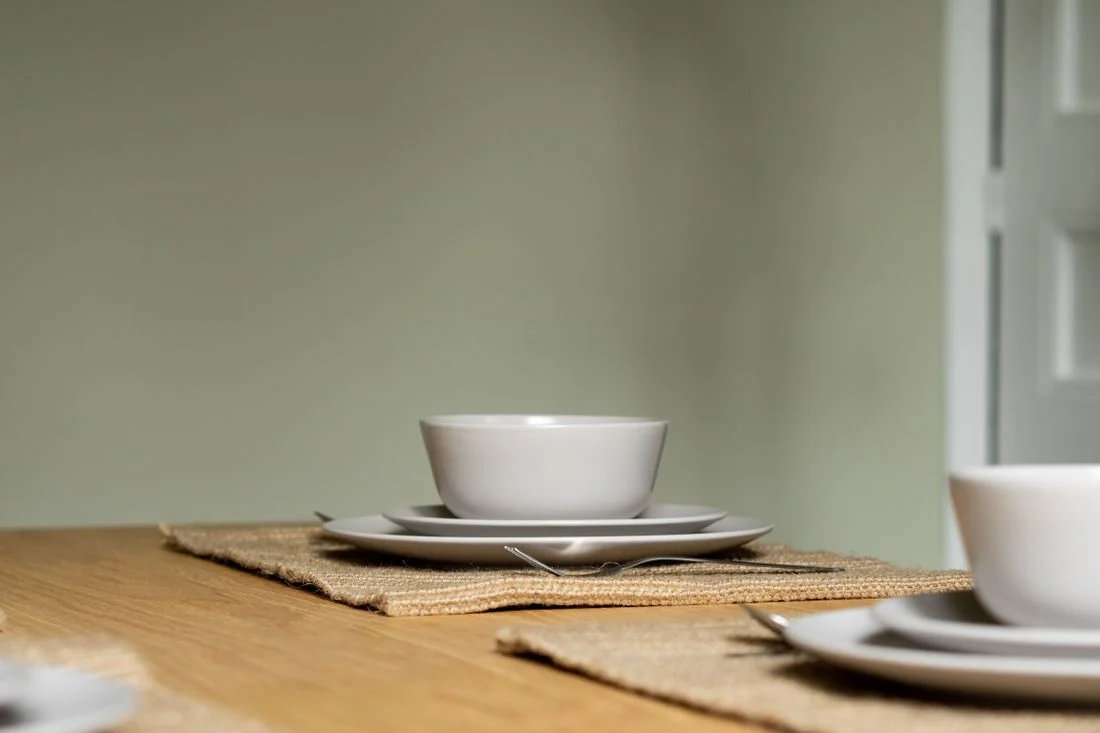
For bowls, look at capacity and shape together. A deep bowl with a small base may stack differently from a broad shallow bowl. Check whether a stack remains stable and whether the top bowl can be lifted without sticking to its neighbor.
Handle one piece before committing
Weight, rim shape, and surface feel vary within material categories. The words stoneware or porcelain alone do not tell you whether a particular plate will feel comfortable to carry. Lift a small stack if possible, and consider the user who finds heavy dishes difficult.
Check the maker's statements about dishwasher, microwave, and oven use. Decorative finishes and individual designs can have different limits, so do not generalize from another collection made of the same material. Care requirements should fit the routine you are willing to maintain.
Compare a set with open stock
A boxed set can be convenient when its proportions match your needs. Open-stock pieces let you choose different quantities and replace an individual item later, although continued availability is never guaranteed. Look at the current range and replacement options without treating a product line as permanent.
For example, a two-person household that uses four bowls between breakfast and dinner but only two large plates may benefit from buying extra bowls instead of another entire set. The useful question is what remains missing at the end of a normal day, not how many pieces the box advertises.
Let the finish support everyday use
A neutral base can mix with serving pieces you already own, while a colored or patterned collection can be just as usable if you enjoy seeing it daily. Check how the pattern relates to food and to the table rather than trying to match every object in the kitchen.
Buy a small quantity first when possible. Use it, wash it, stack it, and serve an ordinary meal on it. A successful dinnerware choice feels comfortable through that whole cycle, not only when the pieces are arranged together for the first time.