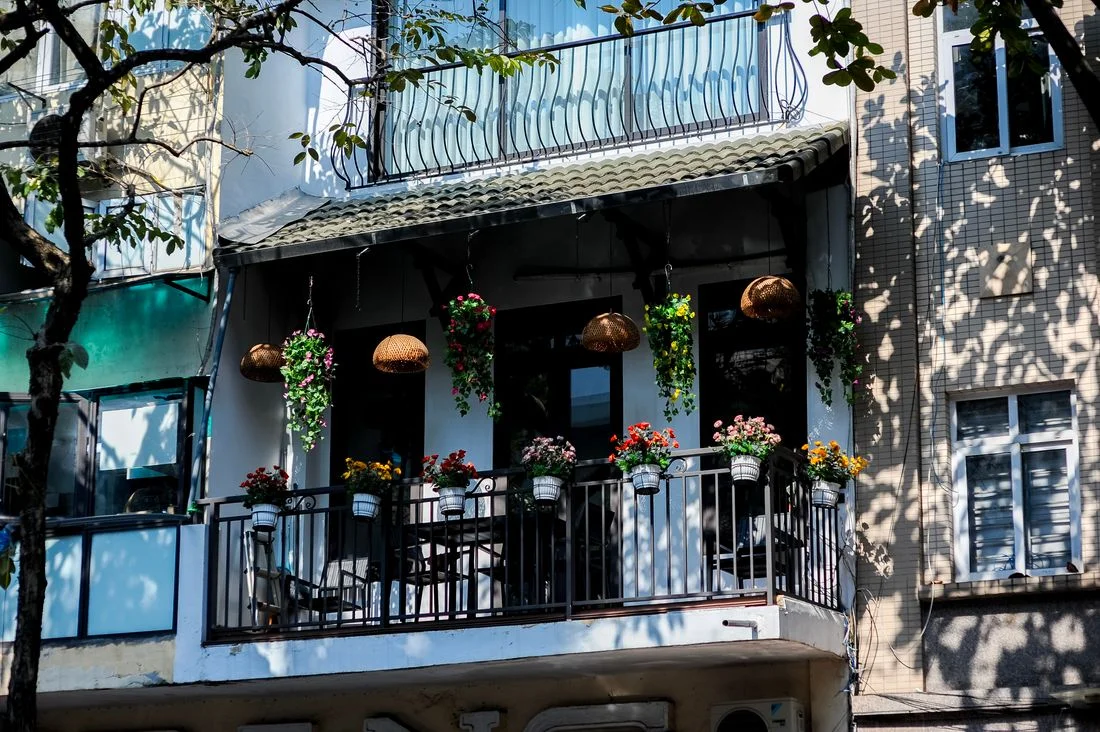
Railing planters seem to offer free planting space because they leave the floor open. In reality, they move the problem to a more demanding location. A filled container must remain securely supported, water must go somewhere, and the building may have rules about what can be attached or placed outside the railing.
Start with those conditions before browsing flowers. Ask the building manager or owner whether railing planters are permitted and whether they must sit on the inside. A product described as balcony-friendly is not evidence that it is appropriate for your particular railing.
Match the planter to the actual support
Measure the railing's shape and dimensions, including any curves or wide top cap. Check the planter manufacturer's compatible rail profiles, fixing method, and load guidance. The weight of soil, water, the container, and a mature plant all belongs in the assessment; an empty display model is not a useful load comparison.
Do not improvise with cord, loose hooks, or brackets intended for another product. If compatibility or structural capacity is uncertain, get appropriate building or professional advice, or choose floor-standing containers instead. A secure floor arrangement can still leave much of the balcony open if its footprint is planned carefully.
Keep everything accessible from inside
You should be able to water, inspect, and remove the planter without leaning over the edge. Consider how you will reach the far side of a long box and whether the planting will eventually cover its attachments. Maintenance should remain possible after the flowers have filled out.
Avoid creating a perch or climbable arrangement near a railing where children might access it. Keep furniture and planting layouts consistent with the building's safety requirements. Decorative planting should not alter the protective function of a balcony boundary.
Plan drainage before planting
Read the container's drainage design. Where will excess water leave it, and can that water fall onto people, windows, or a balcony below? A reservoir system has its own filling and overflow requirements; it should not be assumed to eliminate runoff under all conditions.
Use the recommended growing medium and drainage arrangement for the plants and container. Check the moisture in the actual planter rather than copying an indoor watering schedule. An exposed railing can experience different sun and wind from a sheltered floor pot a few feet away.
Choose a manageable plant shape
A compact plant or controlled trailing habit is easier to maintain than a vigorous plant that grows far beyond the box. Consider the mature size and the local growing conditions, not just the display at the garden center. A single compatible planting style can look more coherent along a railing than many unrelated plants fighting for limited space.
Repeat a small set of colors if the railing is long. On a short balcony, one or two well-maintained containers may be enough. Leave room to inspect the support and operate doors or shutters.
Finally, decide how the planter will be handled during severe weather and at the end of the growing season. Follow the product and building instructions for removal or protection. If that routine is difficult, a smaller planter—or keeping the planting on the floor—may be the more usable choice.