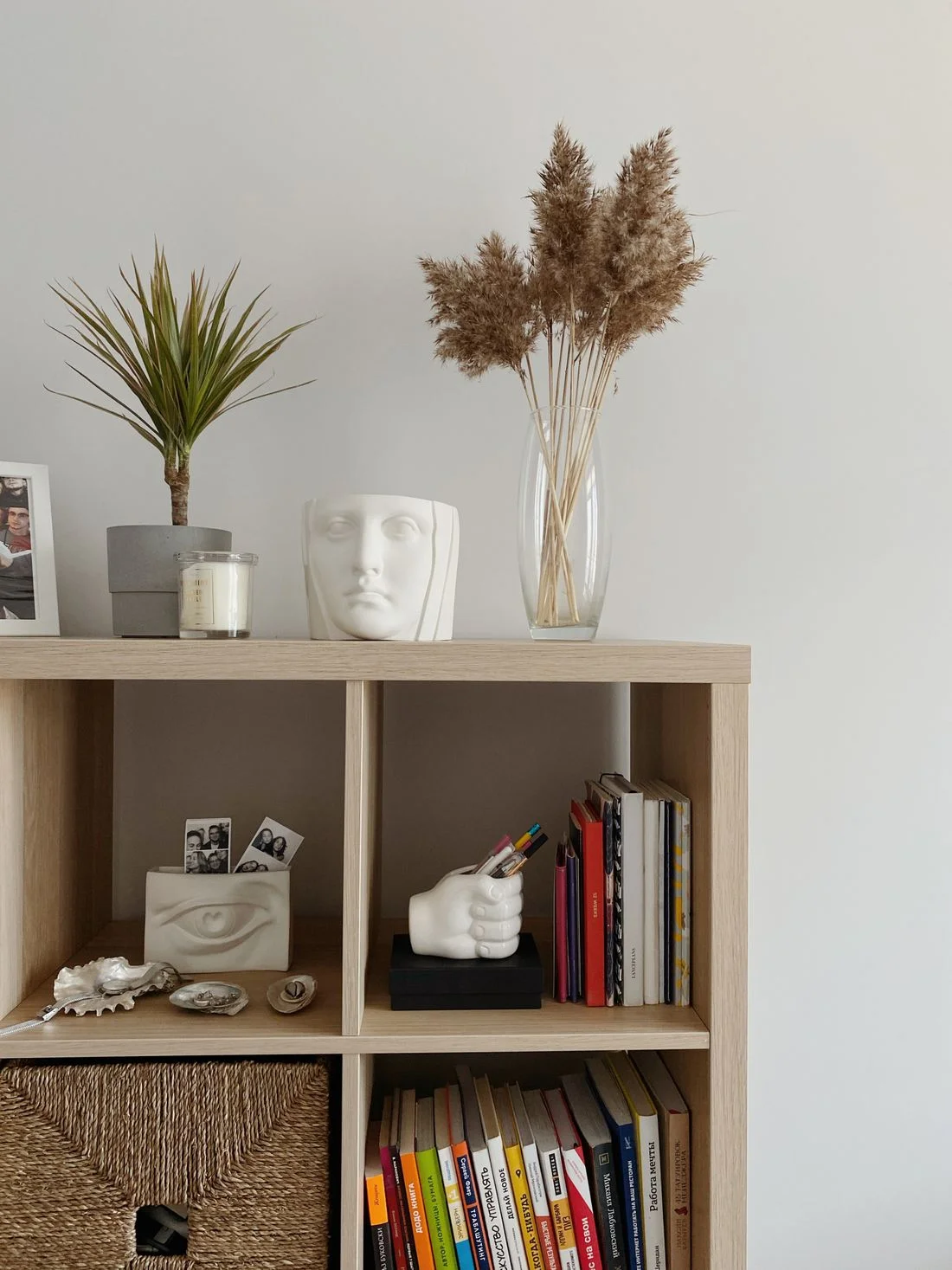
An open shelf can become crowded gradually: a vase arrives, a souvenir needs a home, and a few books migrate from another room. Eventually every gap is filled, yet no object seems particularly visible. Restyling does not have to mean buying a coordinated collection. It often begins by taking enough away to see the shelves again.
Empty one section at a time and put back the things you want to use or see. Keep a separate group for items that merely ended up there. This makes the choice less about whether an object is attractive in isolation and more about whether it belongs in this particular display.
Build around the useful objects
Books you read, a bowl used for keys, or a box of stationery deserve accessible positions. Decorative objects can fit around that activity. Avoid placing a vase on top of the book you reach for every week, or arranging several fragile pieces in front of a useful storage box.
For a shelf beside a chair, the reachable level might hold current books and a small object. Higher shelves can carry less frequently handled pieces. Heavy items belong where the furniture and shelf system are designed to support them; follow the unit's load and anchoring instructions rather than treating visual balance as a structural rule.
Vary the shape of the spaces
Instead of leaving the same small gap around every item, create a few larger clear areas. A cluster of three related objects can sit beside an open patch. A row of books might occupy most of another shelf, with only a small pause at one end. This variation keeps the arrangement from looking like a retail display.
Stand back after each shelf rather than perfecting every compartment separately. The whole unit should have a rhythm. If the tallest objects form an accidental staircase, move one. If all the dark pieces collect on one side, distribute them only as much as the room needs; perfect symmetry is optional.
Give small objects a setting
A tiny keepsake may disappear on a deep shelf. Place it near the front where it can be seen, or group it with one larger related object. Do not solve the problem by adding five more tiny objects. A shallow tray can establish a group, provided it does not make the items harder to reach.
Photograph the finished shelf from the room's normal viewpoint. Images tend to reveal crowding that your eye has become accustomed to. Remove one or two uncertain pieces and leave the display alone for a few days. Empty space is useful when it makes the things you kept easier to notice and easier to live with.