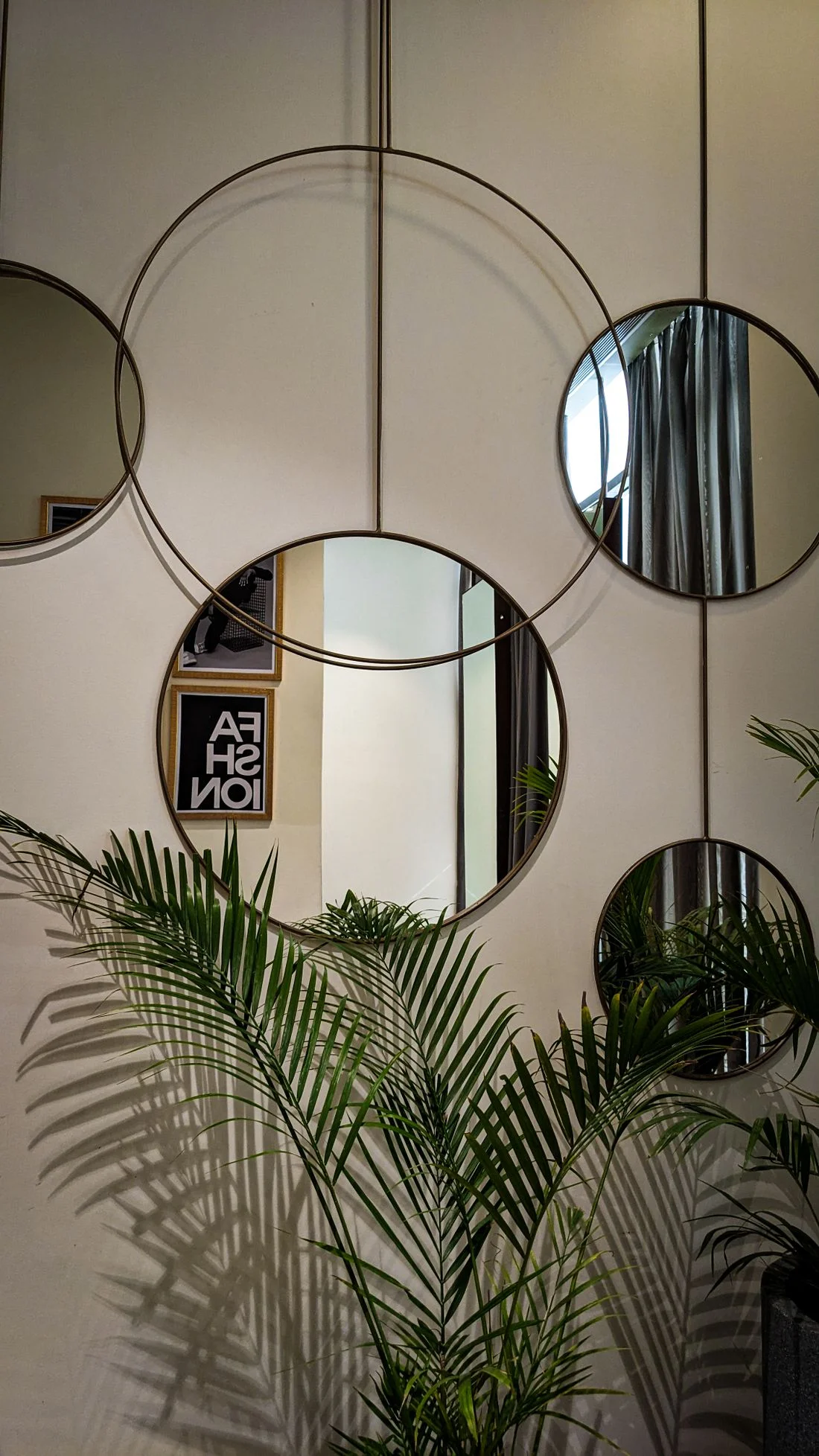
Several round mirrors can turn a plain wall into a composition without filling it with a large rectangular frame. The challenge is that each circle reflects a different fragment of the room. A grouping can feel graceful from the front and strangely busy from an angle, so it pays to plan both its outline and its reflections.
Begin with the area the group should occupy, not the number of mirrors in a boxed set. Over a console, let the furniture establish the visual center. On a wall beside a chair, consider the whole sitting corner, including the height of the lamp and any plant.
Draw one outside shape
Cut paper circles to the actual outside sizes and arrange them on the floor. Transfer a promising layout to the wall with suitable removable tape, testing the tape first. Look at the group from across the room. Its outer boundary should read as a single shape, whether that is a loose oval, a rising diagonal, or a compact cluster.
Unequal circles usually need unequal spacing. A small mirror can sit closer to a larger one, while two equally large circles often need a more generous gap. Rather than following a rigid distance, check whether any gap looks like an accidental hole. Avoid tiny slivers of wall that make two frames seem almost, but not quite, touching.
Repeat one detail
Keep a connection between the frames: similar metal color, a shared slim profile, or the same wood finish. You can vary size without varying every other feature. If the mirrors have very different decorative edges, reduce their number and let each one remain legible.
A nearby plant brings a softer silhouette, but its leaves should not conceal half the grouping. Place it to one side and check its expected mature spread. A mirror arrangement that depends on constantly pushing leaves away will become annoying quickly.
Test before mounting
Use the smallest actual mirror to inspect reflections at the planned positions. Watch for exposed bulbs, a distracting television screen, or a view into a room you would prefer not to reveal. Evening checks are especially useful because multiple small mirrors can repeat one bright light many times.
Mark each hanging point separately using the maker's hardware guidance. A decorative set may contain mirrors with different weights and attachment positions, even when their fronts look identical. After installation, step back and simplify the surface below. The mirrors already provide movement; a console crowded with reflective objects can make the whole wall feel restless.