A colorful throw can supply a room's pillow palette without requiring a matching set. It already brings several colors together, so the work is partly done. The trick is to borrow selectively and to keep the sofa's main job—comfortable seating—in the foreground.
Lay the throw across the sofa in the way you actually use it. A blanket folded over one arm contributes a smaller patch of color than the same blanket spread across the back. Choose the cushion arrangement for that real position, not for an unusually elaborate display you will dismantle every evening.
Find the quiet color first
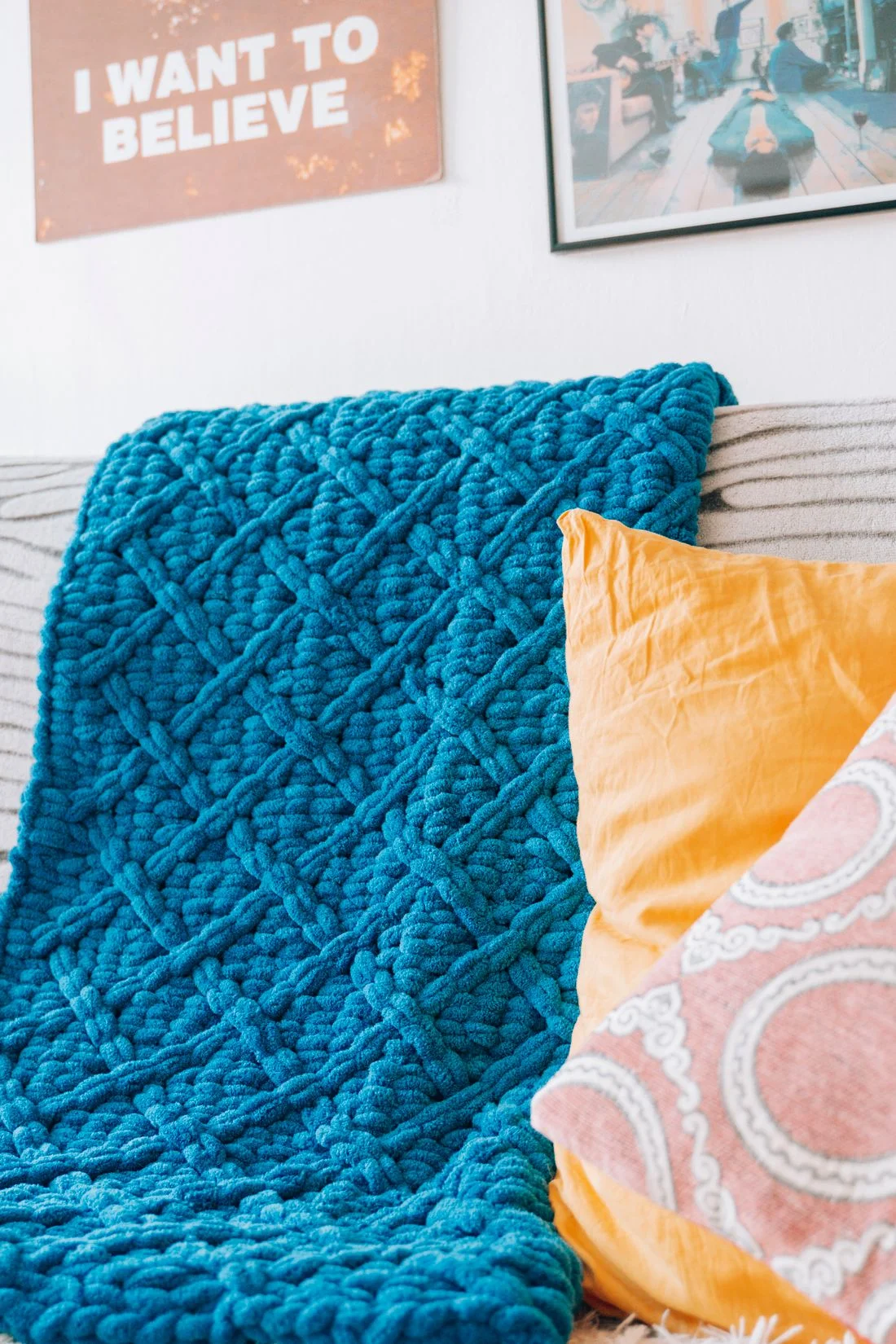
Look for the throw's background or a subdued secondary color. Use that for the largest cushion. Then choose a smaller cushion in one stronger accent. If the throw has blue, orange, cream, and pink, you might use a cream cushion and a muted orange one, leaving the blue to the blanket itself.
Exact color matches are not essential. A slightly dusty version of a bright color often sits more easily beside existing upholstery. Compare the fabrics together in the room; photographs and screen swatches are unreliable guides to subtle differences.
Change texture before adding another pattern
A knitted throw already has visible texture. Pair it with a smoother cushion cover, then decide whether a patterned cushion is still needed. If you add one, choose a clearly different scale from the throw's design. Several tiny busy patterns can blur into one restless surface.
Consider how the cushion feels against an arm or cheek. A decorative weave, heavy embroidery, or a line of buttons may be better on a chair used briefly than in the main reclining spot. Removable covers are convenient only if their care instructions fit your habits.
Stop before the seats disappear
Sit down with the cushions in place. If everyone immediately puts them on the floor, reduce the number or size. On a compact sofa, two well-chosen cushions can be more useful than a layered arrangement of five. Leave a spot where the throw can be reached without pulling everything apart.
When the season changes, keep the quieter cushion and replace just the accent or the throw if you want a different mood. A palette built from a few relationships is easier to adapt than a set of pieces that only works when every item is present.